Duration
4 Months
September 2022
December 2022
Team
Yongwen Dai
Alana Levene
Jacob Chen
Wendy Ju
Tools
Figma
Miro
Adobe suits
Project Overview
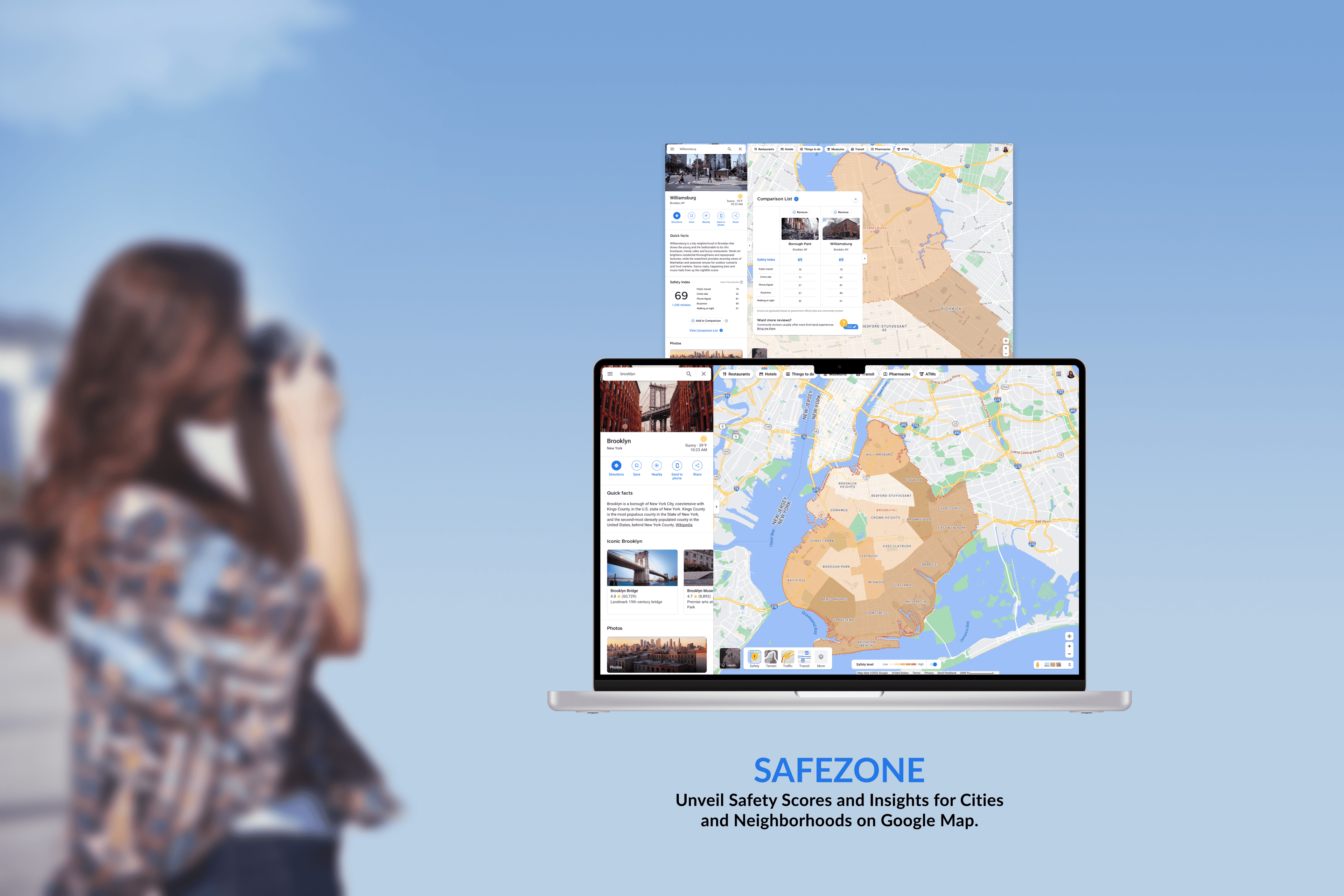
Women have the right to feel safe while traveling. While we can’t fix the world’s problems in one fell swoop, we can arm women with the information they need to make informed, data-driven decisions, and to feel more secure and confident in their travel planning – from choosing a city to visit, to selecting a hotel, or deciding whether it’s safe to go to a bar in a new neighborhood at night.
Our goal in designing SafeZone was to help women feel secure and confident that their travel plans meet their safety standards. SafeZone is convenient and easy to use. It seamlessly incorporates into existing tools like Google Maps, which we found to be a common tool for day-to-day travel planning.
My Role
Research: Semi-structured interviews, Surveys, Contextual Inquiry, Speed Dating, Storyboarding.
UX Design: Concept generation, low-fi prototype, high-fi prototype.
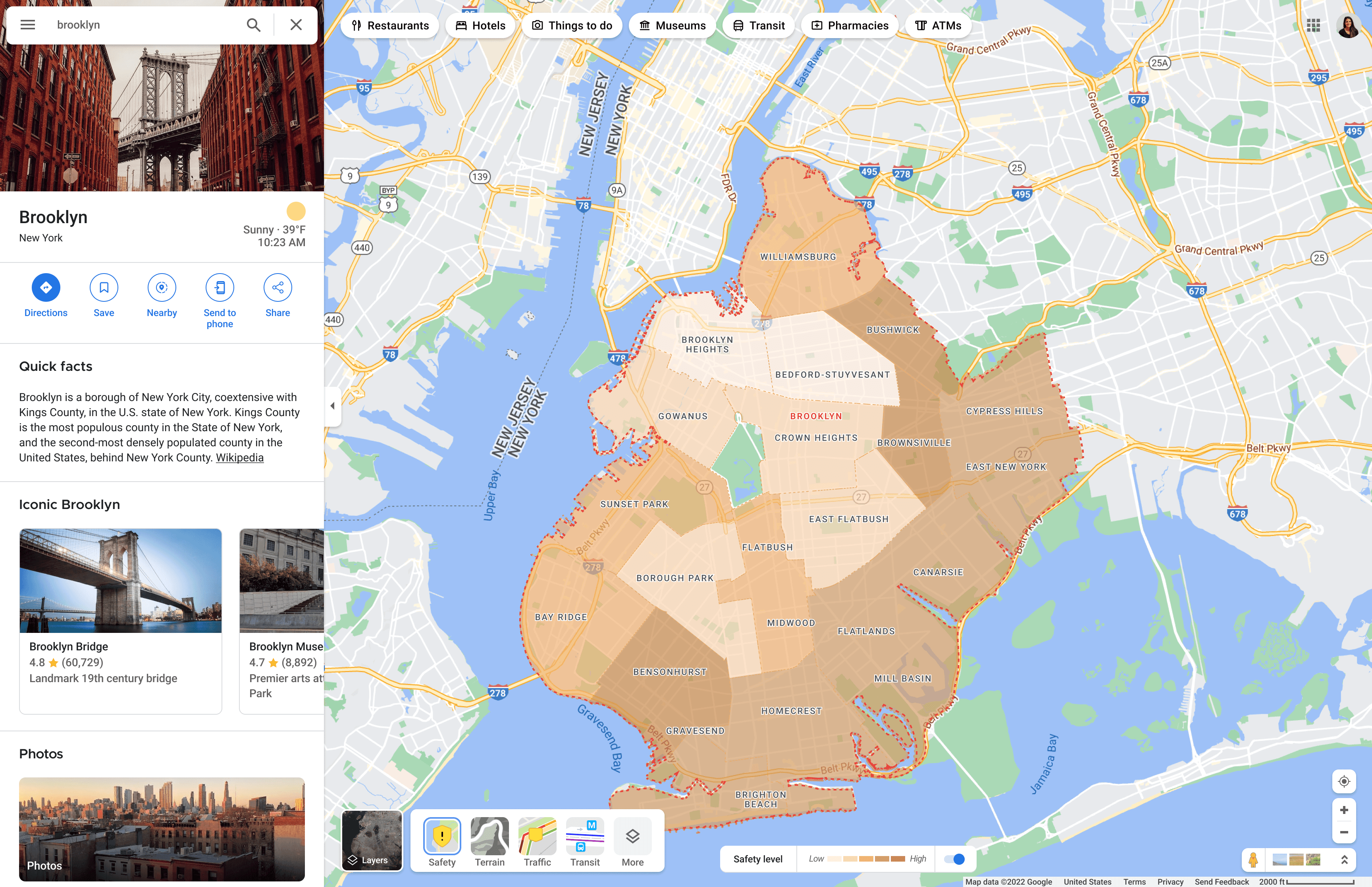
Locality
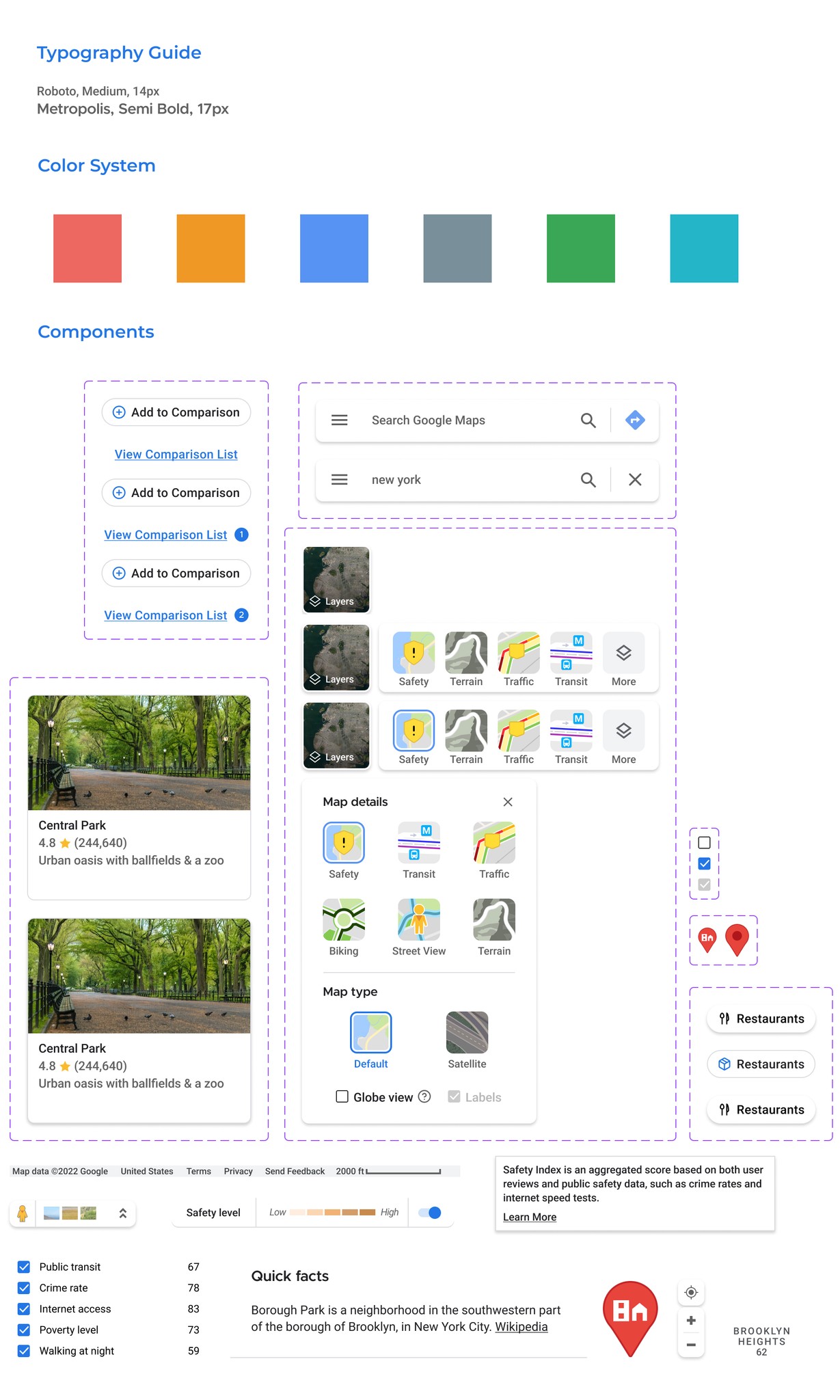
See the breakdown of safety scores that measure safety levels among cities and neighborhoods.
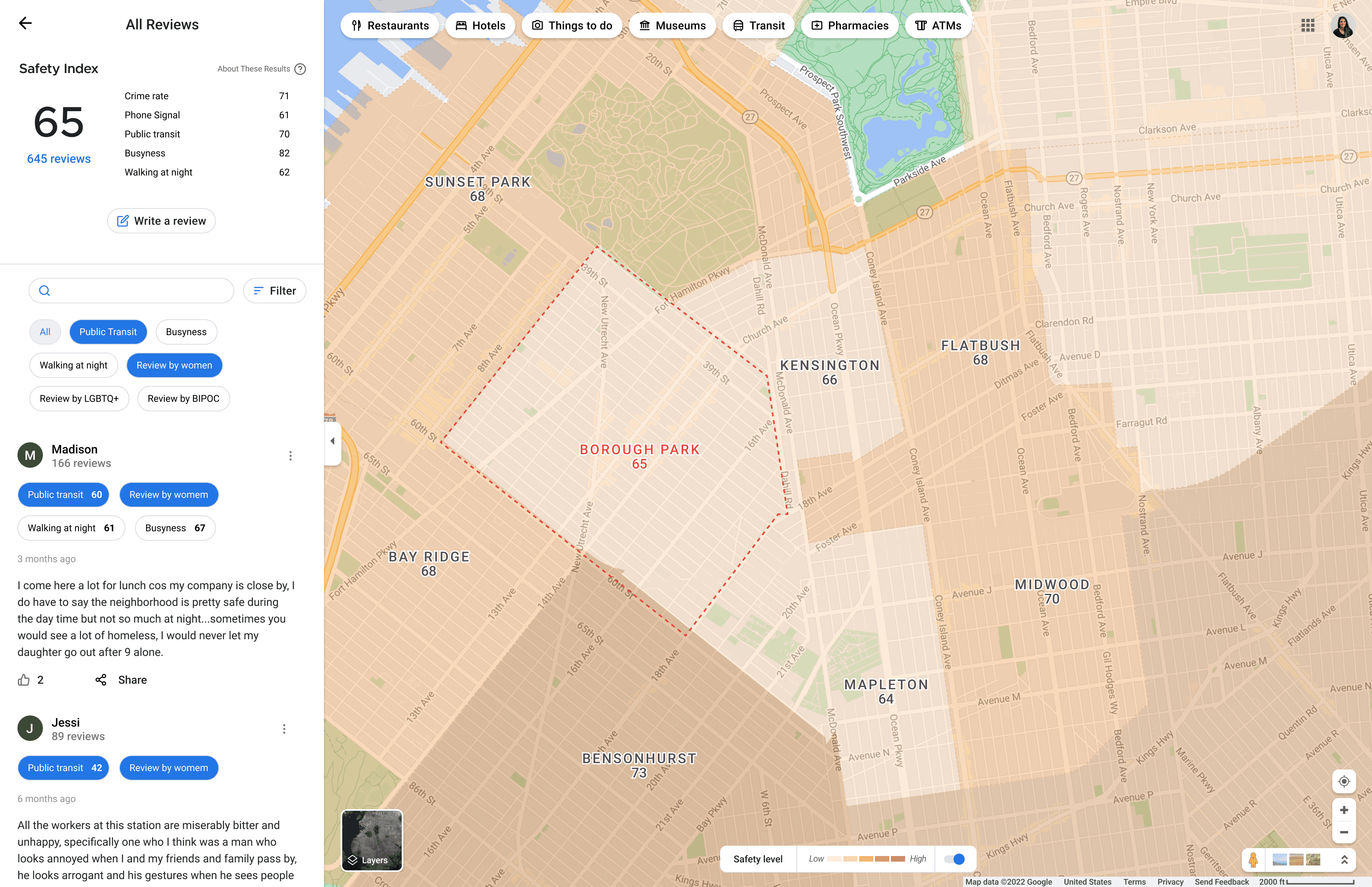
Community
Users can filter reviews by identity, preference, and other personal concerns.
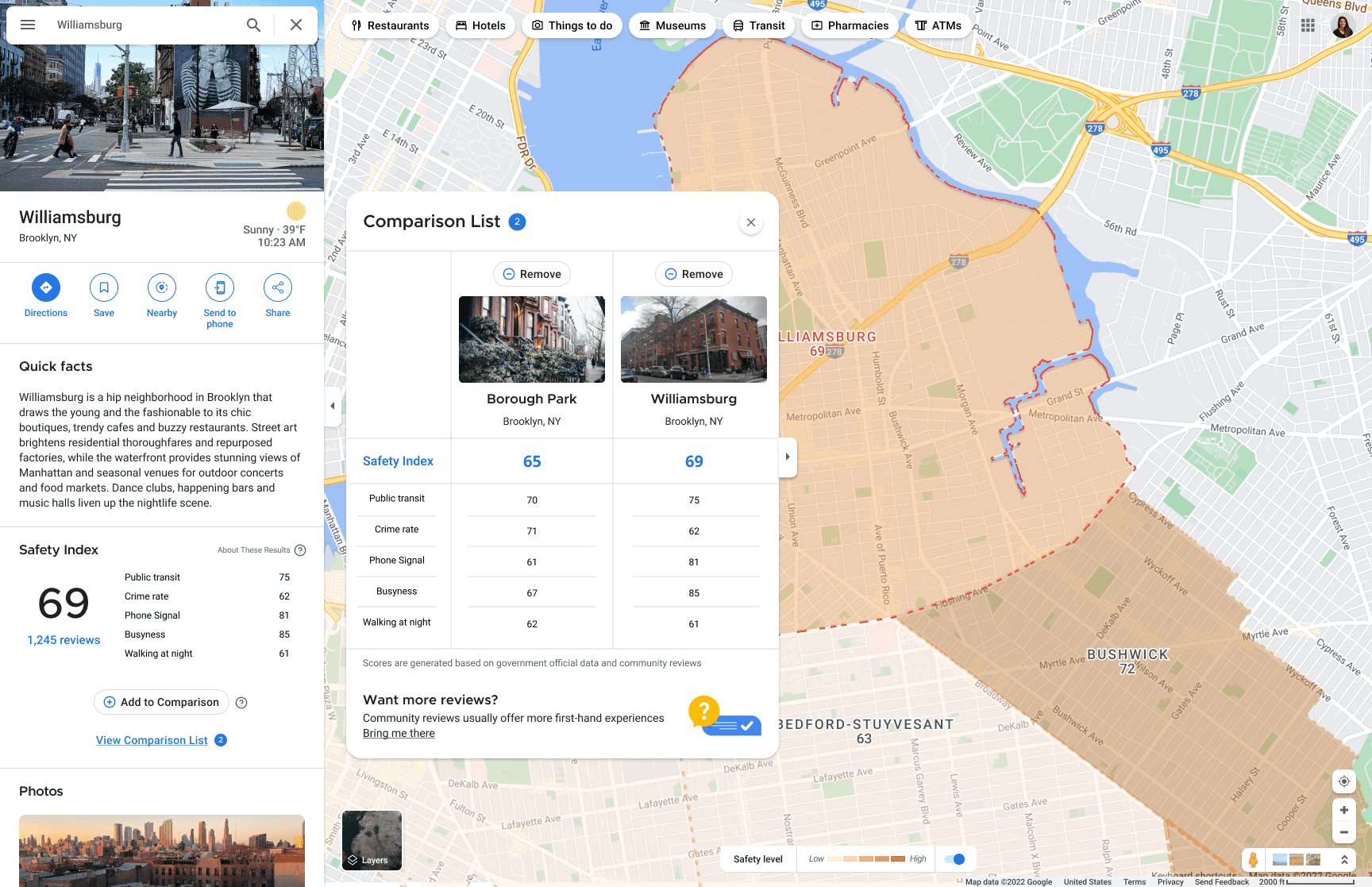
Decision making
Select cities or neighborhoods that you’re interested in. Open the list view to see how they compare.
Project Review
Impacts
Increased User Satisfaction
Utilizing the System Usability Scale, we facilitated usability testing, which yielded an impressive satisfaction rate exceeding 85%.
Enhanced task success rate
We conducted three iterative rounds of prototype development to specifically address women's confidence in safety concerns, improving click task success rate by 30%.
Improved Solo Travel Confidence
Project Overview
Design Process

Design Research
Literature Reviews
Because of physiological differences, women have more possibilities to get hurt during their travels in a new place. They usually tend to feel unsafe and unconfident. We found some data to uncover this problem.
While traveling, have you ever felt threatened or uneasy?
46%
Yes
42%
Somewhat
12%
No
While traveling, have you ever been attacked or assaulted?
12%
Yes
88%
No
Do you feel you have the skills to defend yourself?
55%
Not at all confident
43%
Somewhat confident
2%
Yes, I’m very confident
While traveling, where do you most feel at risk?
45%
On a street at night
30%
On a street at day timeNo
28%
While in transit
10%
At a hotel
3%
In a restaurant or a bar
🤔
Design Research
Semi-structured Interviews
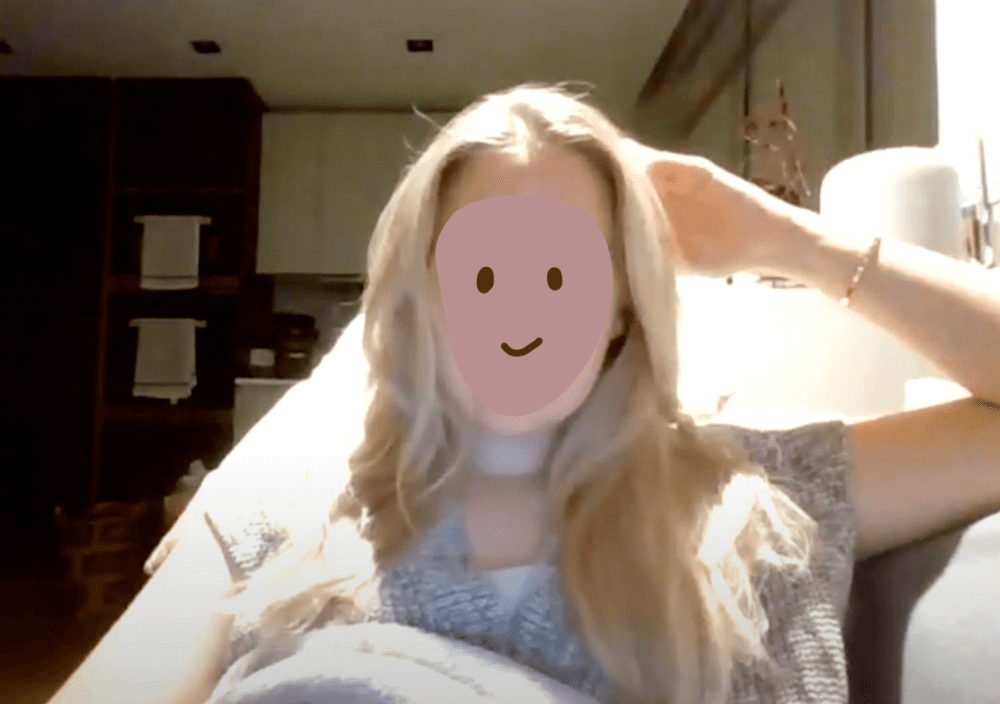
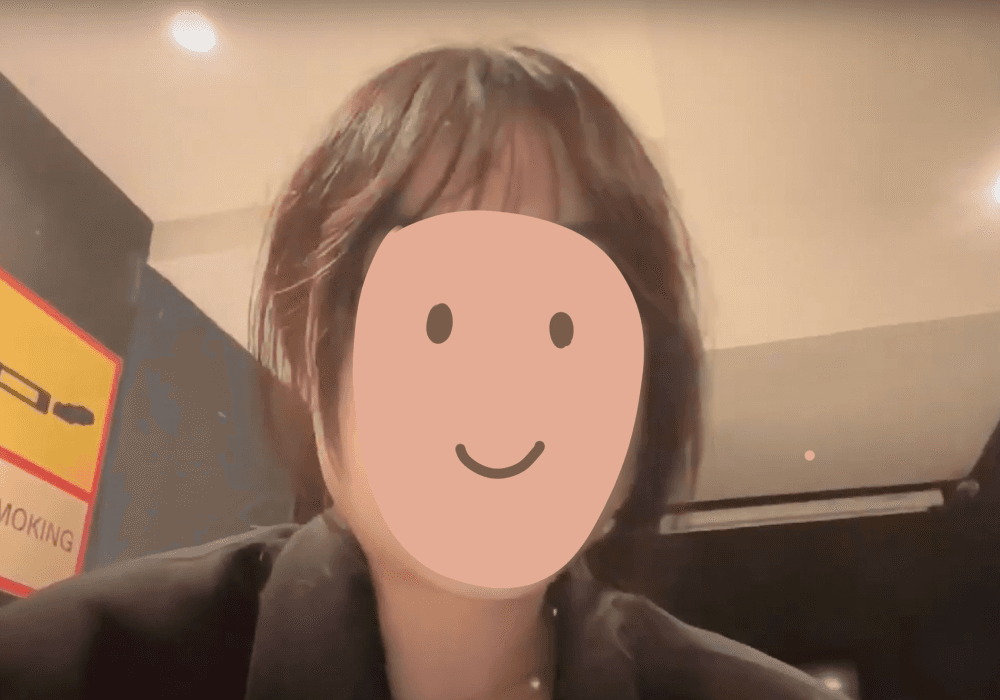
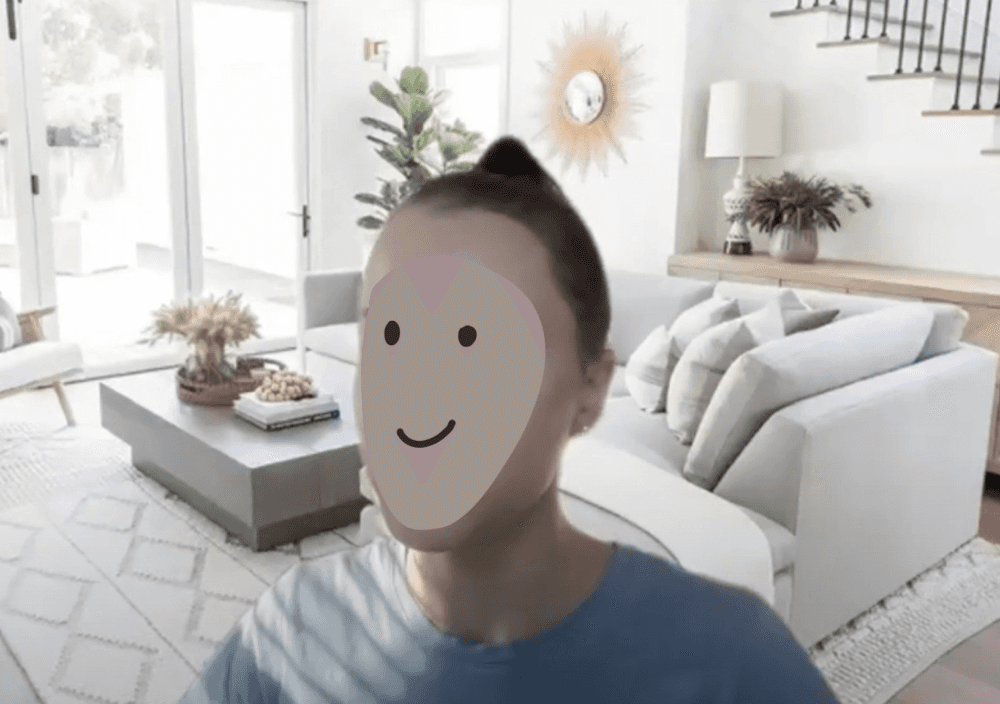
To better understand the difficulties women are facing when they do their travel planning, we recruited 4 participants to help us conduct the semi-structured interviews. All the participants are women who have traveled solo and women who want to travel solo. Our goal for this interview is to understand women’s concerns and their expectation during the solo travel planning.
The main research method we are using is directed storytelling, which encouraged participants to share their experience about solo travel.

Design Research
Walk the Wall
We printed all the interpretation notes and findings from literature review and pasted all the work on the wall. We tried to analyzed ad group each category to find out the female solo travelers’ needs.
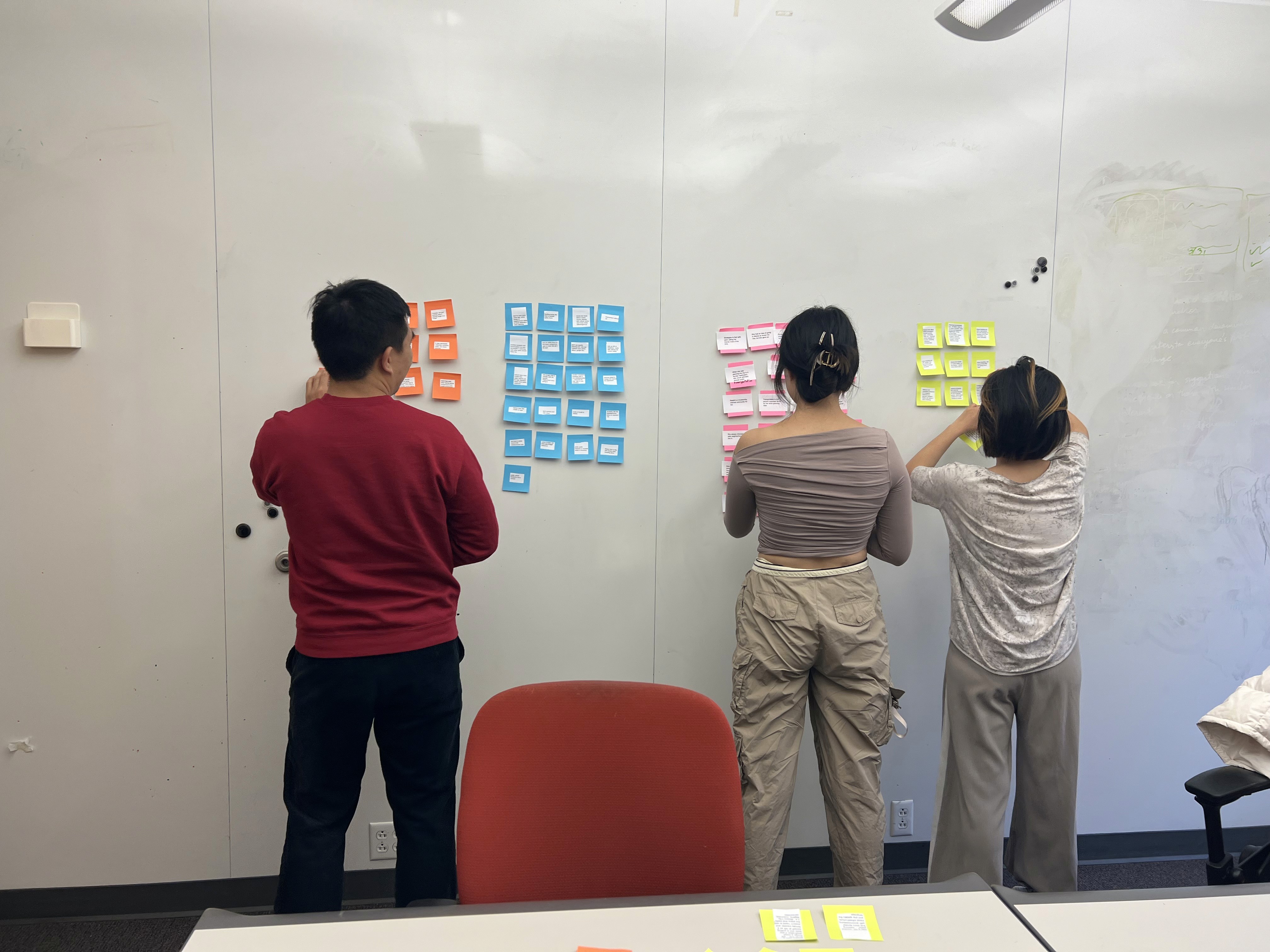
Listing all the interpretation notes
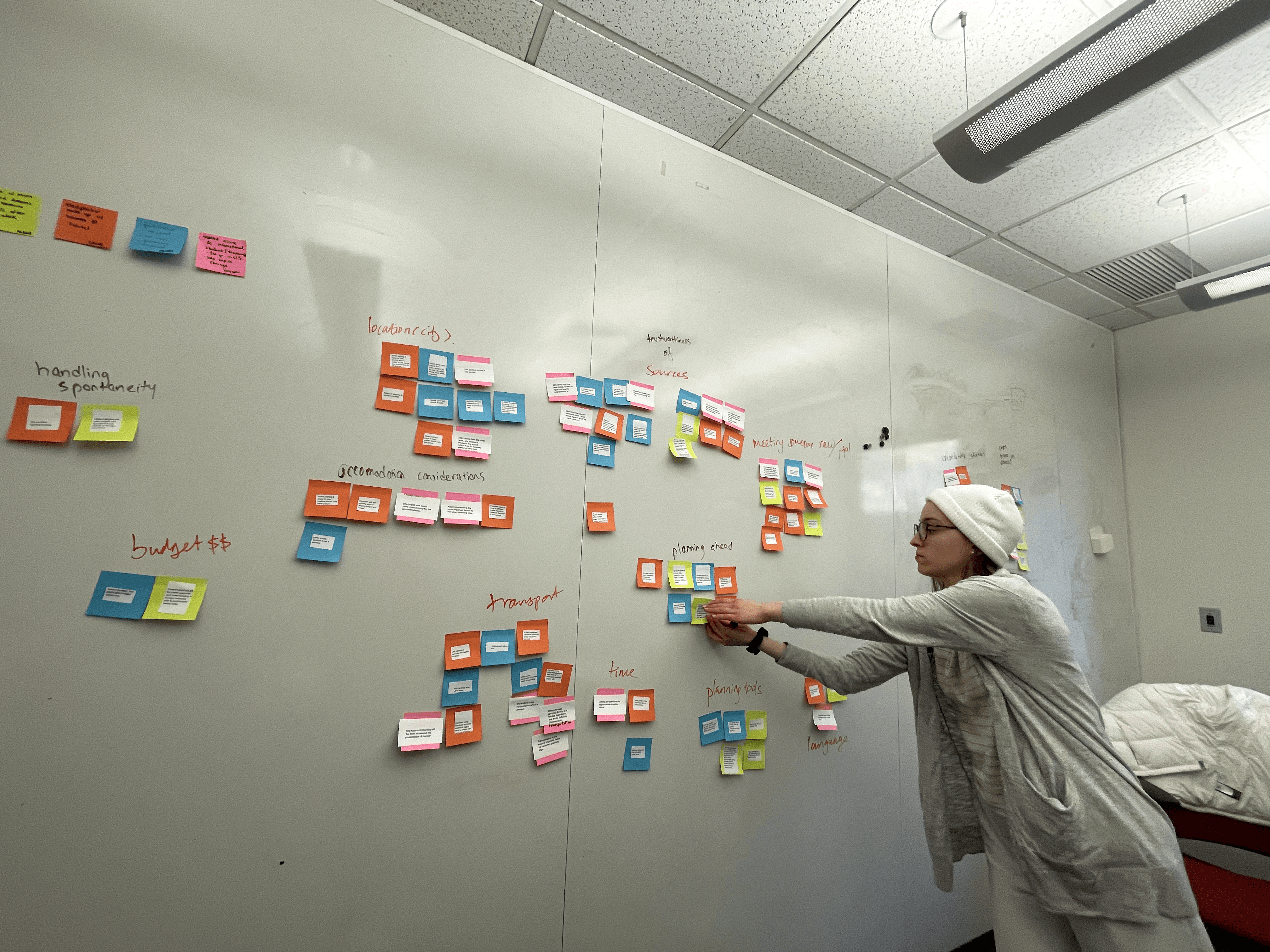
Grouping the notes
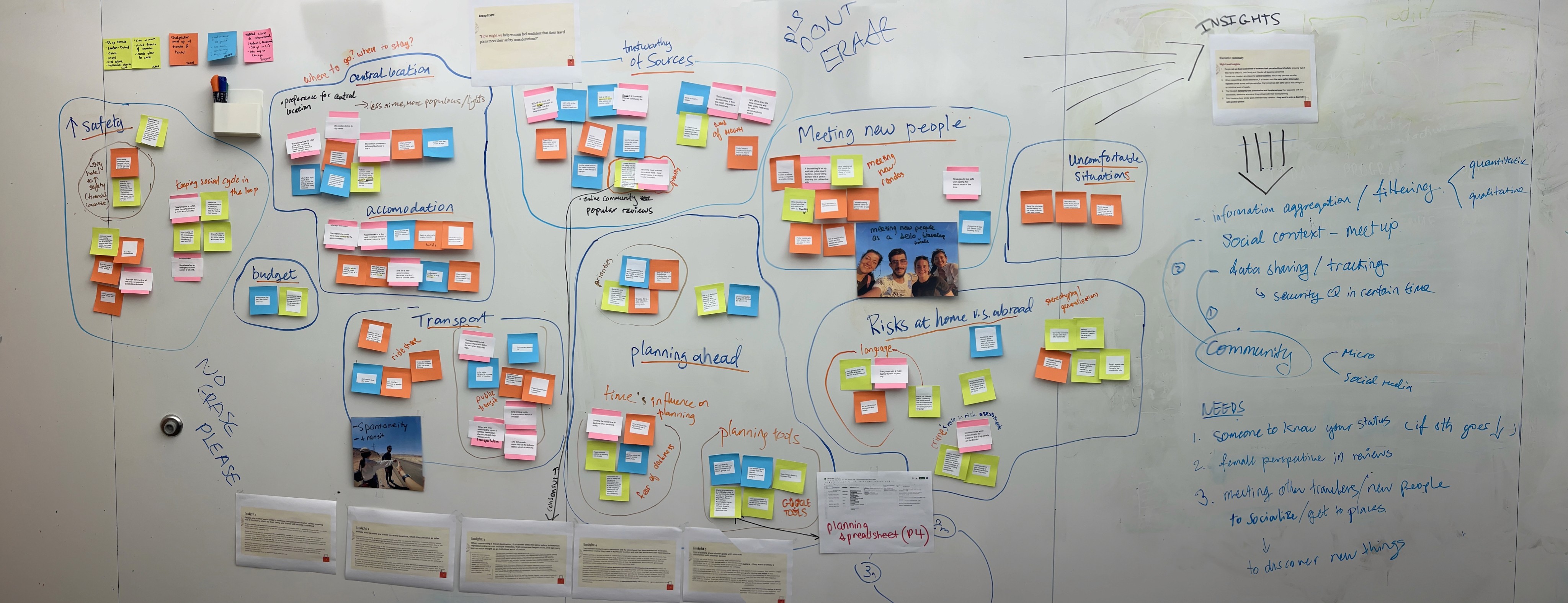
Affinity Diagramming after grouping
Design Ideation
Speed Dating
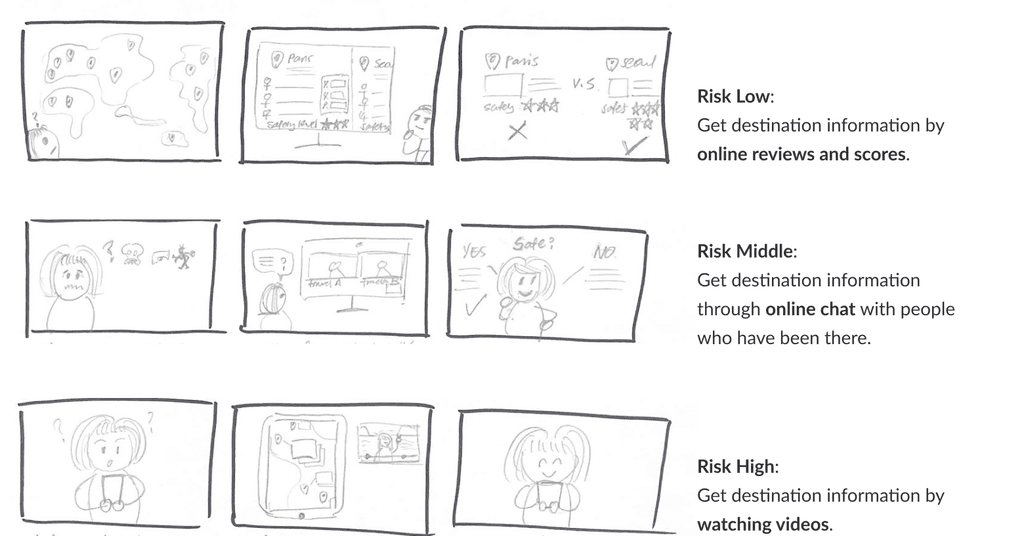
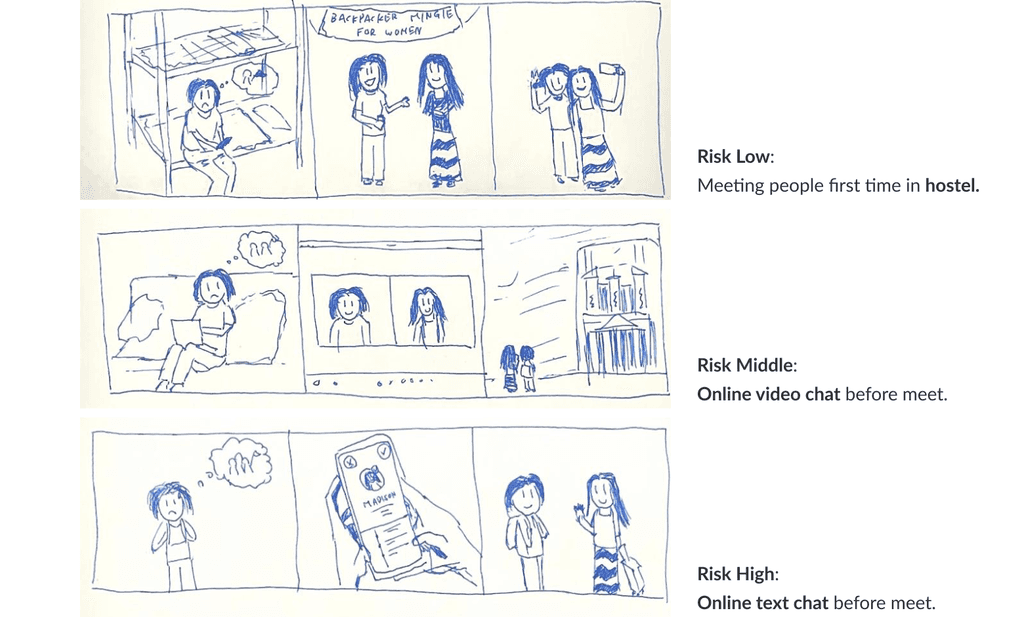
Speed Dating is an ideation method which structures comparison of concepts, helping identify and understand contextual risk factors and develop approaches to address them.After we synthesizing and grouping all the notes, each of us tried to figure out women’s needs individually and generated 8 solutions in 10 minutes (crazy 8s). We voted and found out 3 common needs. We made 3 storyboards for each need to test the uncertainty and risk, also testing if we clearly understand users’ needs or not.
Click to see the full report
Crazy 8s
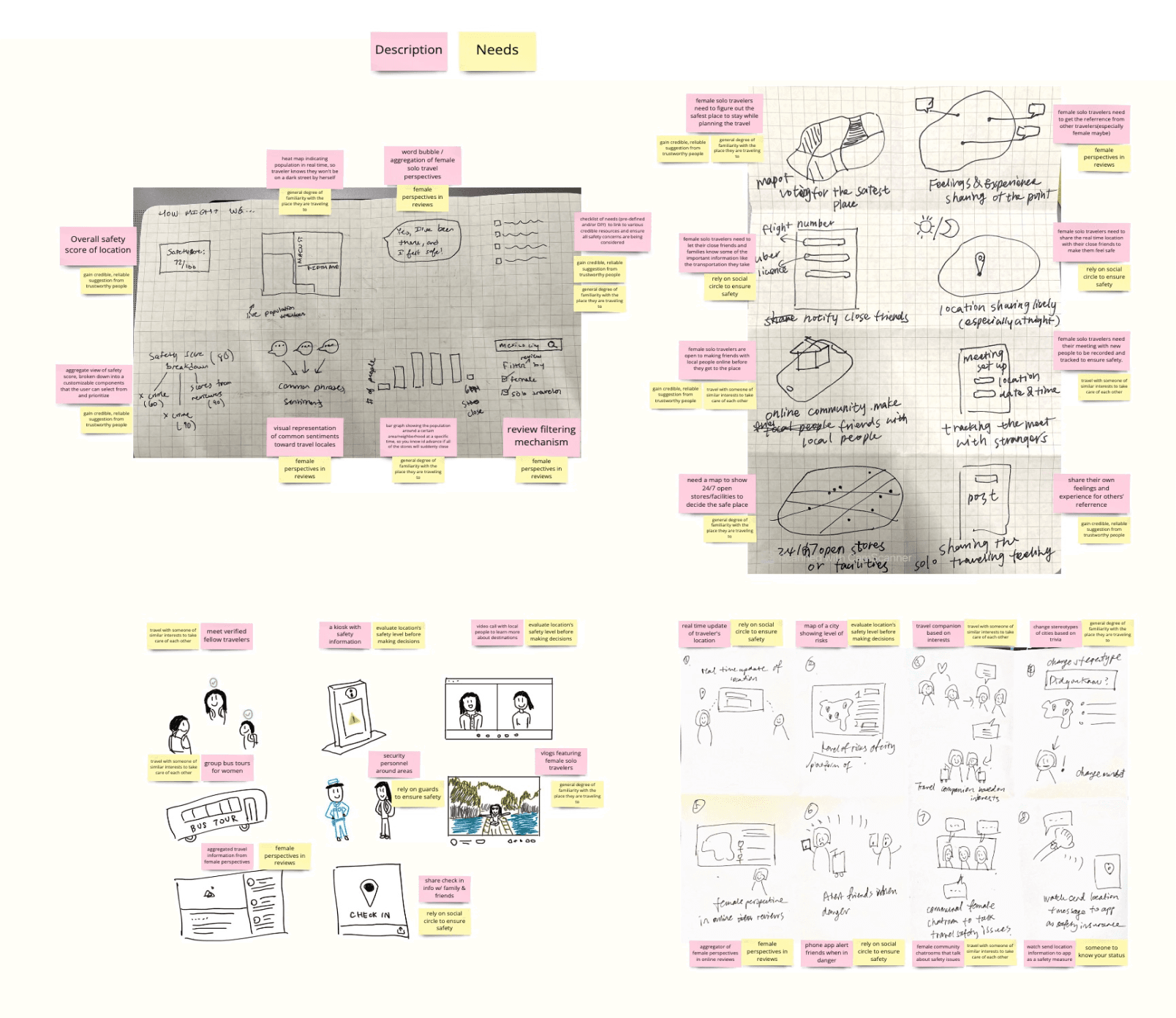
Needs & Solutions
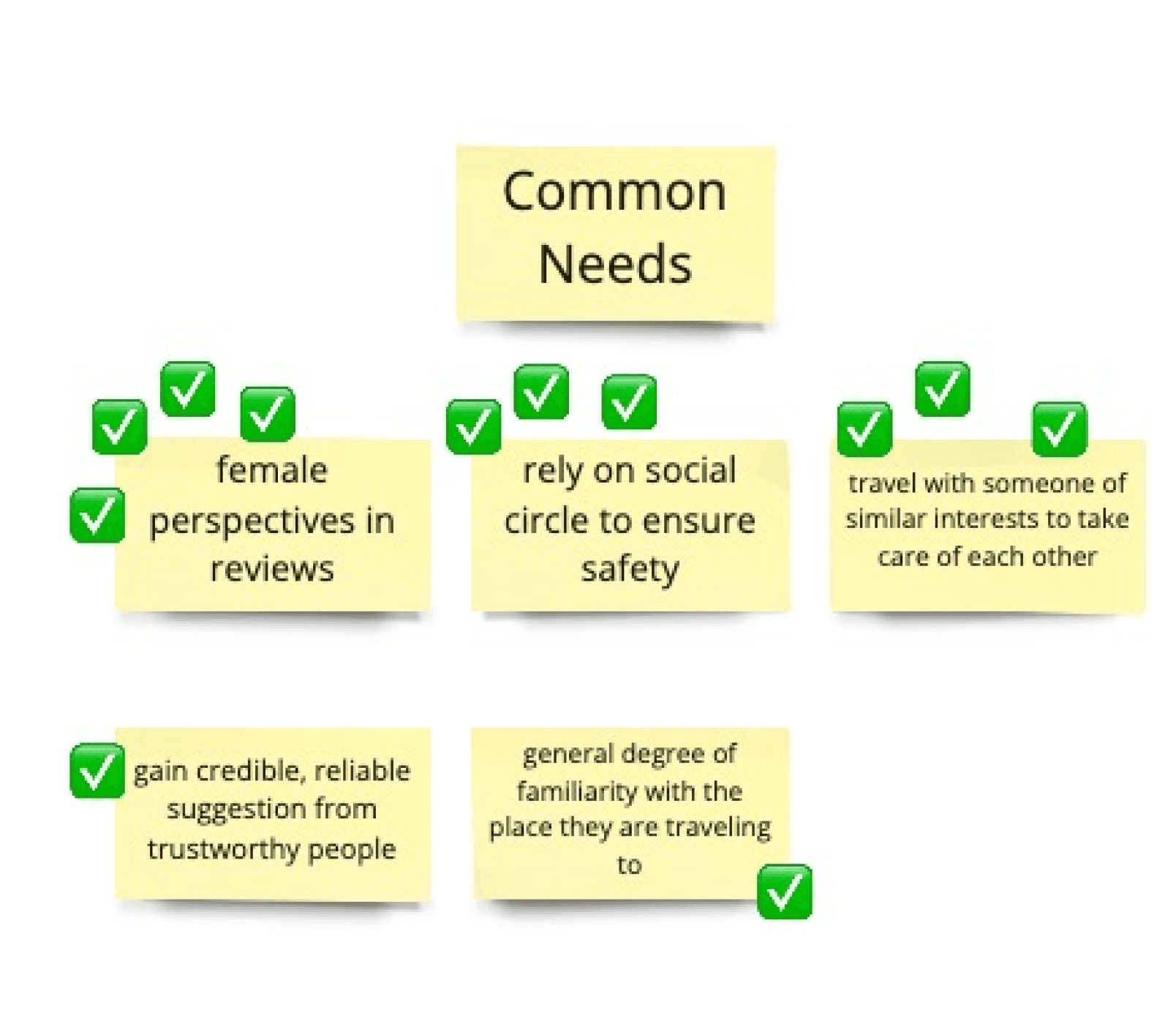
Voting
User Needs
1. A close friend or family member to know if something goes wrong
2. Female solo traveler perspectives in reviews → Information aggregation/filtering (qualitative/quantitative)
3. Meeting other travelers/new people to socialize/find to places to discover
Storyboards
User Need 1 - A close friend or family member to know if something goes wrong.
Leading Question:
Do you ever wish your friends and family would automatically be alerted if you were in trouble/danger while traveling?
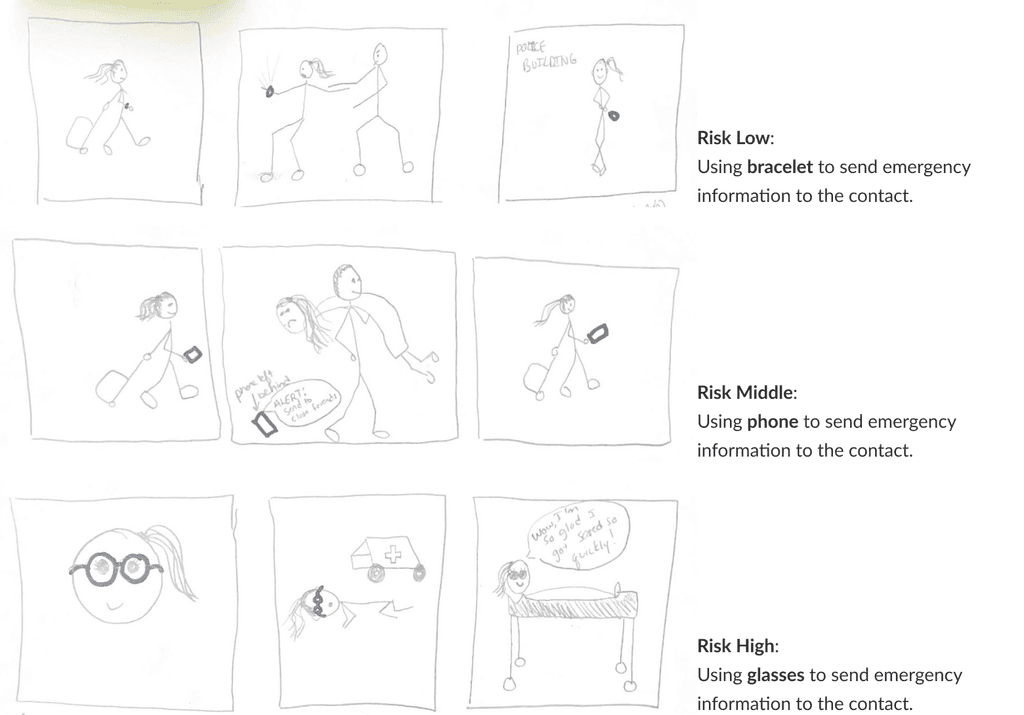
User Need 2 - Female solo traveler perspectives in reviews.
Leading Question:
Do you wish you could see an aggregate view of female travelers perspectives of different travel destinations?
User Need 3 - Meeting other travelers/new people to socialize
Leading Question:
Would you like to meet new people when traveling?
Speed Dating Feedback
The second need - viewing the reviews is the most essential one to female solo travelers.
1
Women want a female-perspective about safety but non-gender-specific concerns (like guns) are same important.
2
Text reviews synthesized with a map is the most intuitive and convenient way to get reference.
3
Insights
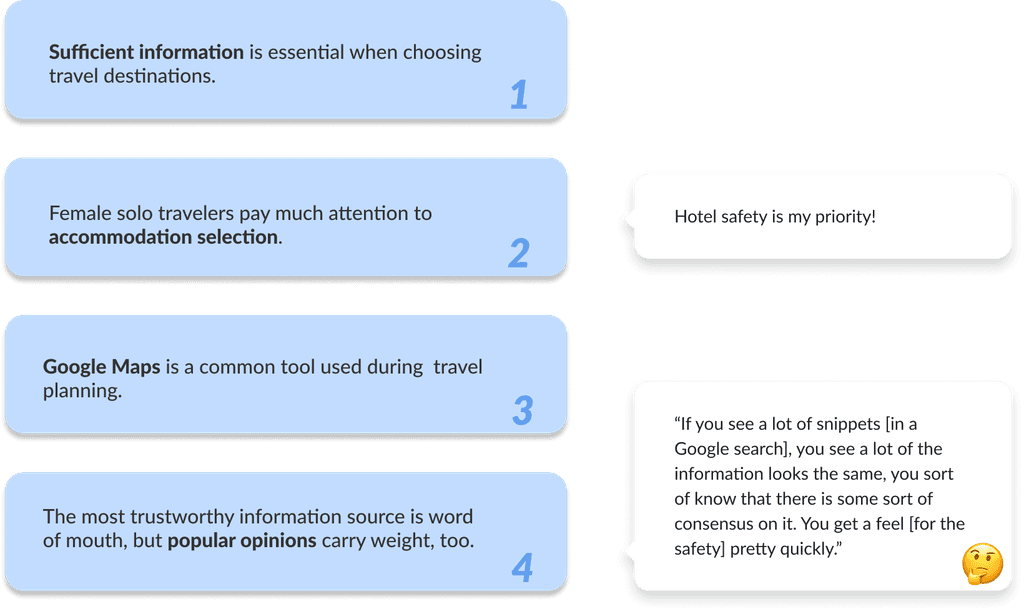
What if we create a new map layer for Google Maps, which
equips with a numerical scoring system with various safety index,
allows people to check others’ reviews ,
and enables travelers to do the comparison among potential destinations?
Design Ideation
Surveys
Goals
Since we decided to design a map with safety information, we planned to conduct surveys to:
Understand the dimensions solo-traveling women look for when researching the safety information of a destination.
Test the hypothesis of a numerical score as a delivery method for indicating safety levels.
Test our assumptions regarding what safety components women consider before traveling.
Click to see the survey
Analysis
28 responses were collected and the followings are the data we cared most.
What factors do you consider when assessing the safety level of a potential travel destination (e.g., a city or a neighborhood)? (choose all that apply)
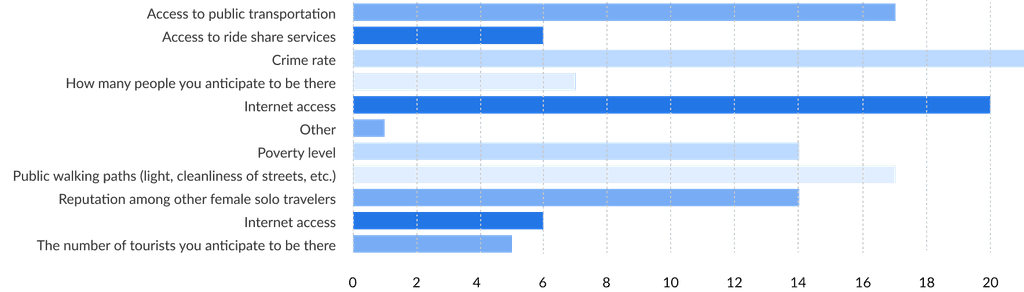
What type of information would you like to see when assessing a travel destination's safety? (Choose all that apply)

Findings
Top 5 concerns for women are crime rate, internet access, access to public transportation, public walking paths, poverty level, and reputation among other female solo travelers.
Numerical score is popular same as the traditional ways(images, videos).
In our prototype, we need to include text-based reviews to provide context for our safety score, as evidence of how we come up with it and increase confidence in our potential users for it.
UX Design
Design System
UX Design
Hi-fi Prototype
UX Evaluation
Usability Testing
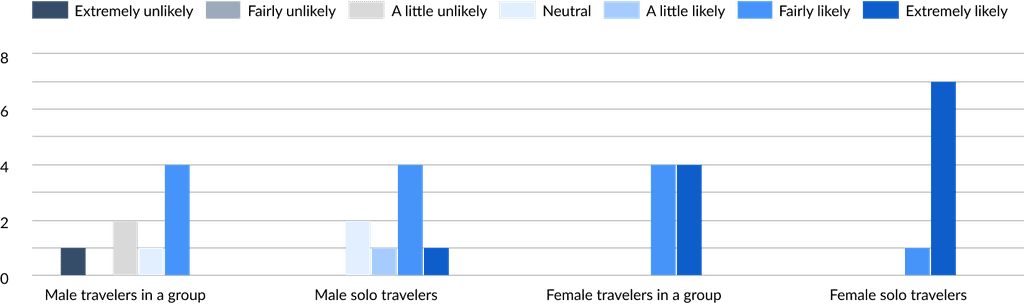
Honest signals after testing
People explicitly express a higher confidence level in using our new safety feature implemented in Google Maps to plan their trips
1
People would recommend this to female travelers just as much, if not more, than other groups (e.g., male travelers in a group, solo male travelers, female travelers in a group)
2
People can tell the specific situations that they will choose to use this tool.
3
Feedback after testing
Each of us recruited 2 participants to do the testing (8 participants in total). We assigned three tasks (open safety overlay map, check safety score, compare safety scores of different districts) to each of the participants to see if they could make it successfully. Also, each of the participants helped us fill in the questionnaire to share their feelings about this testing. Finally we got 8 responses.
UX Evaluation
Reflection
In general this research and design journey is amazing. I love the semi-structured interviews part most. Everytime I had a chance to listen to my participants’ stories, I could feel their helplessness, uncertainty and fear while they were traveling alone. “I felt scared when it was after sunset.” One of my interviewees said, “I booked the hotel in the wrong neighborhood so I had no choice but to come back earlier to make me feel safe, which made me not fully enjoy that trip.” Her feelings firmed our ideas to help women collect sufficient information. And when I showed her our prototype, she was happy and told me she should have it before that trip! I am so delighted since it is such a big compliment to our work! We hope more and more women could be equipped with confidence to enjoy the world!
I contributed mostly in concept generation, visualization materials, evenly in research and ideation. I am not so confident in writing and I was worried I couldn’t make it good when composing the report. But the summary and conclusion of the research is essential, it gives you a chance to recall the work you have done and find more insightful information from that. I hope I can get more training in the future.
I have to appreciate my teammates. They are wonderful partners and amazingly professional. Our collaboration synthesized the ideas together. Each person has unique and insightful findings which makes our project complete!